DB Studio
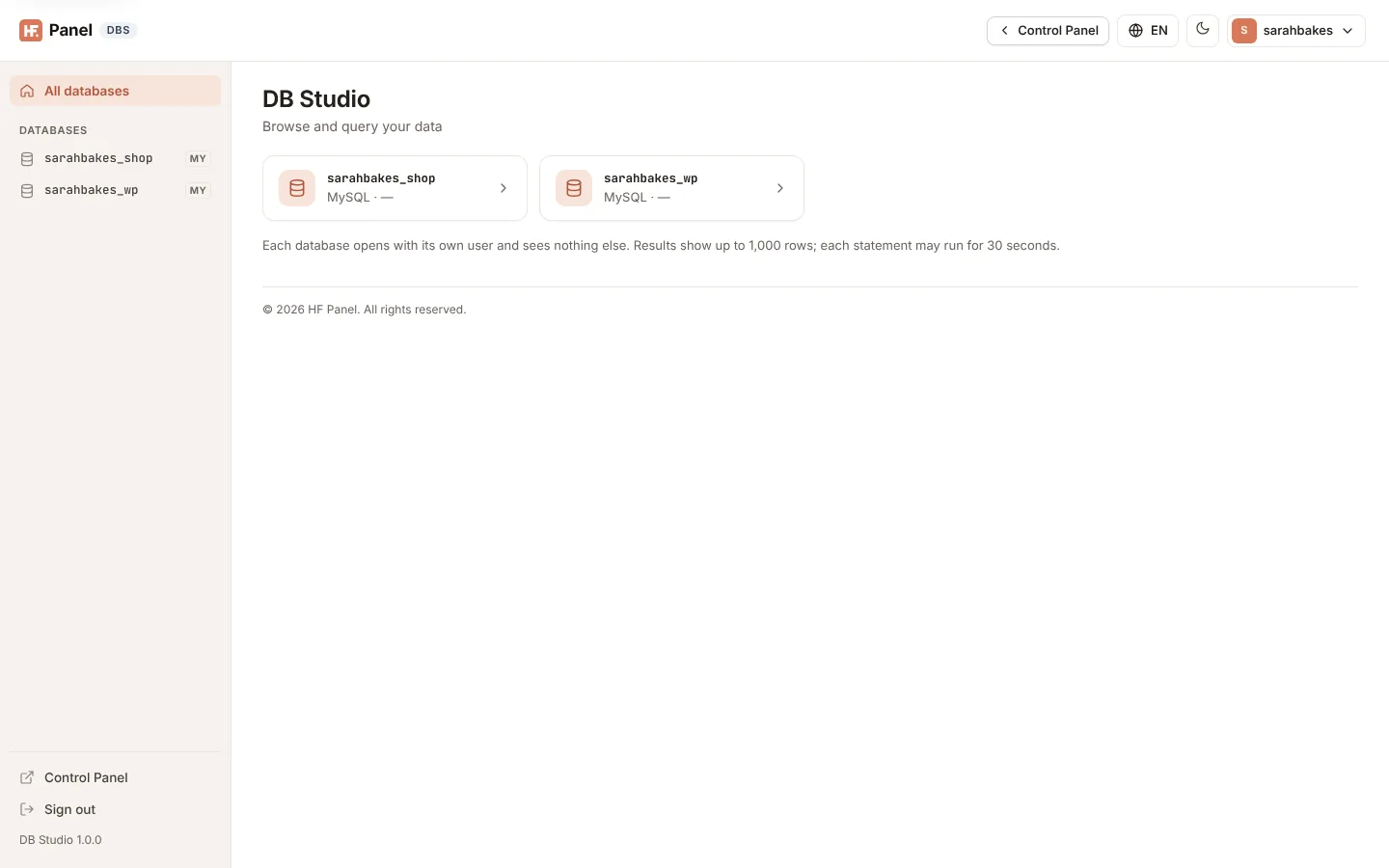
Sign in to DB Studio, the database app of HF Panel, see your MySQL, PostgreSQL and MongoDB databases and open one.
DB Studio shows the databases of your hosting account in the browser. You can browse and edit rows, see the structure of tables, run SQL, and import and export. MongoDB databases have their own views for collections and documents.
Where: https://dbs.yourdomain.com, or Control Panel › Databases › DB Studio
Open DB Studio
From the Control Panel: click DB Studio in the menu (or Browse next to a database). DB Studio opens in a new tab, already signed in, at that database (MySQL, PostgreSQL or MongoDB). The link works once; opened again in a browser that is already signed in, it simply opens DB Studio. If you see That link has expired. Open DB Studio from your Control Panel again., open it from the Control Panel again.
Directly:
- Open the DB Studio address.
- Enter the Username and Password of your hosting account.
- Click Sign in.
With two-factor login on, type the 6-digit Code (or a backup code) and click Continue.
Forgotten your password? resets it on DB Studio's own sign-in page: your username or email, the 6-digit code from the email, then the new password twice.
A session ends after 2 hours without use, and after 12 hours at most.
The database list
The start page lists every database of your account with its engine and size. The side menu lists them too; under the open database it lists its tables (or collections), with a filter box.
| Engine | Opens |
|---|---|
| MySQL / MariaDB | tables, rows, structure, SQL, import and export |
| PostgreSQL | the same |
| MongoDB | collections, documents, indexes, queries, import and export (see MongoDB in DB Studio) |
If you have no databases yet, create one in the Control Panel first (MySQL databases, PostgreSQL databases or MongoDB databases), then open it here.
Note: each database opens with its own database user and sees nothing else. You never type the database's password, except in the one case below. Database users themselves are managed in the Control Panel.
Unlock a PostgreSQL database
A PostgreSQL database that DB Studio can't sign in to by itself shows Unlock this database. Type the password of the database user and click Unlock. It is kept only while you are signed in.
When a database can't be opened
- PostgreSQL isn't running on this server or MongoDB isn't running on this server: those databases can't be opened until the server's administrator starts the service.
- DB Studio opens databases on this server only: your account's databases are on another server of the cluster.
A database's tabs
Open a database, then a table in the side menu. The tabs are:
| Tab | What it does |
|---|---|
| Rows | browse, search, filter, sort, add, edit and delete rows (Rows and structure) |
| Structure | columns, indexes, foreign keys and the CREATE statement |
| SQL | the SQL box (The SQL box) |
| Import & export | .sql and CSV files (Import and export) |
An empty database opens on SQL, with buttons to Open the SQL box or Import.
Keyboard and mouse
DB Studio works like a desktop database tool. Press ?, or the keyboard button at the top, to see every shortcut.
On a Mac, ⌘ takes the place of Ctrl. Shortcuts don't fire while you type in a box, except the SQL box's own.
Rows, SQL results and MongoDB documents
| Key or mouse | What it does |
|---|---|
| Click | Selects a cell |
Shift-click, Shift + arrows, or drag |
Selects a block of cells |
Ctrl-click |
Adds a row to the selection, or takes it out |
Shift+Space / Ctrl+A |
Selects the whole rows of the selection / every row |
Arrows, Home, End, PgUp, PgDn |
Move between cells (Ctrl + arrow, Ctrl+Home, Ctrl+End: to the edge) |
Enter, F2 or double-click |
Edits the cell in place (MongoDB: opens the document) |
Enter / Tab / Shift+Tab |
Saves the cell / saves and edits the next or previous cell |
Esc |
Cancels the edit |
Ctrl+C |
Copies the selection as tab-separated text: a block of cells without a header, whole rows with a header line of the column names. It pastes into a spreadsheet as cells. |
Delete |
Deletes the selected rows, after you confirm |
Right-click (long press on a touch screen, the menu key, Shift+F10) |
Copy, Copy as SQL INSERT, Edit, Set NULL, Delete row and Filter by this value |
| Click a column heading | Sorts by it; click again for the other way |
| Drag a column heading's edge | Resizes the column; double-click the edge to undo |
Delete always deletes whole rows. To empty one value, use Set NULL in the right-click menu (it is greyed
out when the column can't be NULL). A value shown cut (longer than 300 characters) opens the row's Edit row
form instead of editing in place, and is copied in full.
The SQL box
| Key | What it does |
|---|---|
Ctrl+Enter |
Runs the selected text, or the statement the cursor is in. Error lines count from the top of the box. |
Ctrl+Shift+Enter or Run |
Runs everything in the box |
Ctrl+/ |
Turns the selected lines into comments (-- ), or back |
Tab / Shift+Tab |
Indents / outdents the selected lines |
Esc, then Tab |
Leaves the box, so the keyboard can move on to the next control |
In the MongoDB query box, Ctrl+Enter runs the query.
Moving around: the browser's Back and Forward buttons, and the mouse's back and forward buttons, go through the tables, filters and queries you opened before. Every view has its own address, so you can bookmark it.
Limits
| Limit | Value |
|---|---|
| Time one statement may run | 30 seconds |
| Rows shown for one statement in the SQL box | 1,000 |
| Statements in one run of the SQL box | 200 |
| Text in the SQL box | 1 MB |
| One statement of an import or export | 10 minutes |
| A whole import | 30 minutes |
| Largest .sql file to import | 128 MB, unless your hosting provider set another limit |
Language and look
The language menu at the top switches the interface language. The moon and sun button switches between the light and dark look. Your username opens Control Panel, Password & security and Sign out.